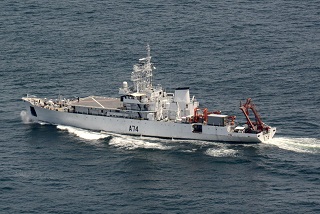
INS Sagardhwani, India’s oceanographic research vessel under NPOL (Naval Physical and Oceanographic Laboratory), DRDO, flagged off for 5th edition of Sagar Maitri (SM-5) on 17 January 2026 from Southern Naval Command, Kochi.
Flagging-off ceremony led by Shri Radha Mohan Singh, MP and Chairperson, Parliamentary Standing Committee on Defence, with DRDO & Navy officials present.
INS Sagardhwani Source: PIB
Purpose of Sagar Maitri:
Flagship collaborative initiative between Indian Navy and DRDO, promoting scientific cooperation and socio-economic collaboration among Indian Ocean Rim (IOR) countries.
Part of India’s vision of MAHASAGAR (Mutual and Holistic Advancement for Security and Growth Across Regions).
Scientific Component – MAITRI:
Stands for Marine & Allied Interdisciplinary Training and Research Initiative.
Focuses on long-term collaboration in ocean research, capacity building, and professional exchanges among IOR nations.
Mission Details:
SM-5 retraces historic routes of INS Kistna from the International Indian Ocean Expedition (1962–65).
Engages in collaborative oceanographic studies with eight IOR countries: Oman, Maldives, Sri Lanka, Thailand, Malaysia, Singapore, Indonesia, Myanmar.
Current mission emphasizes collaboration with Maldives for joint research.
Strategic Significance:
Supports Underwater Domain Awareness (UDA) for the Indian Navy.
Collects oceanographic and acoustic data along predefined observational tracks, aiding maritime security and research.
About INS Sagardhwani:
Specialised marine acoustic research vessel, designed by NPOL and built by Garden Reach Shipbuilders & Engineers (GRSE).
Commissioned in July 1994, operational for over three decades.
Serves as a platform for ocean observations, marine research, and underwater acoustic studies, enhancing India’s maritime scientific capabilities.
Collaborative Outcomes:
Strengthens scientific cooperation, professional exchange, and capacity building among IOR countries.
Contributes to India’s maritime scientific leadership and strategic engagement in the Indian Ocean region.
India’s first open-sea Marine Fish Farming project
Overview of the Initiative
Launched by: Dr. Jitendra Singh, Union Minister of State (Independent Charge) for Science & Technology, Earth Sciences, PMO, Personnel, Atomic Energy, Space, etc.
Location: North Bay, Andaman Sea (Sri Vijaya Puram, Andaman & Nicobar Islands).
Significance: India’s first-ever open-sea Marine Fish Farming project.
Vision: Unlock economic potential of India’s oceans under the Blue Economy framework, emphasized by PM Narendra Modi.
Objectives and Intent
Harness the economic potential of India’s oceans, which remained largely underexplored for nearly 70 years after Independence.
Integrate scientific innovation with livelihood generation for coastal and island communities.
Promote marine aquaculture (finfish and seaweed cultivation) in natural ocean conditions.
Pilot project to enable future scaling via public–private partnerships.
Project Implementation
Collaborating agencies:
Ministry of Earth Sciences, Government of India
National Institute of Ocean Technology (NIOT)
Andaman & Nicobar Islands UT Administration
Focus Areas:
Marine fauna: Cage-based cultivation of finfish using NIOT-developed open-sea cages.
Marine flora: Deep-water seaweed cultivation; seaweed seeds distributed to local fishing communities.
Supports livelihood enhancement, skill development, and local economic opportunities.
Key Highlights of the Field Visit
Dr. Jitendra Singh emphasized the heterogeneous nature of India’s oceans, with unique contributions from western, southern, and eastern seaboards.
The project represents a science-to-field approach, actively involving coastal and island communities.
Reinforces Blue Economy strategy, ensuring sustainable and inclusive utilization of ocean resources.
Related Site Visits
Visited Mahatma Gandhi Marine National Park (MGMNP) near Wandoor:
Established in 1983, first marine park of its kind in India.
Spread across 15 islands, including Jolly Buoy and Red Skin.
Rich marine biodiversity: coral reefs, mangroves, turtles, and various fish species.
Observed sustainable and self-maintaining marine ecosystems, aligning with project goals.
Strategic Importance
Demonstrates government commitment to the Blue Economy and ocean-led economic growth.
Combines livelihood creation, scientific research, and technological innovation.
Sets precedent for scaling through public-private partnership models, potentially covering larger regions in India’s oceanic zones.
Supports India’s position as a leader in marine aquaculture and sustainable ocean resource management.
Space-based Datacentres in Low Earth Orbit
Core Idea
Global datacentre electricity consumption is rising rapidly, driven primarily by AI workloads, especially large language models.
To address energy constraints and sustainability concerns, Google Research is exploring space-based datacentres powered entirely by solar energy under a concept called Project Suncatcher.
Why AI Datacentres Are Different
Traditional datacentres scale mainly with content consumption (e.g., video), requiring similar inbound and outbound bandwidth.
AI datacentres require:
Extremely high internal bandwidth for distributed training and inference
Fast interconnects between GPUs/TPUs rather than between servers and end users
Example:
Microsoft’s Fairwater AI datacentre complexes use petabit-per-second links between facilities.
User-facing bandwidth is comparatively small, similar to how ChatGPT works today.
Rationale for Space-Based Datacentres
Space offers:
Continuous access to solar power, avoiding grid constraints and fossil-fuel reliance
Reduced need for high-capacity Earth downlinks, since most data movement is internal
The idea reframes datacentres as compute clusters in orbit, not as Earth-facing infrastructure.
Project Suncatcher: Proposed Architecture
Inspired by Starlink but fundamentally different:
Satellites form tight, choreographed clusters, spaced only a few kilometres apart
Clusters follow sun-synchronous orbits to maintain constant solar exposure
Key technologies:
Inter-satellite high-bandwidth links
Multiplexing to maximise data throughput per radio beam
Primary bandwidth demand is between satellites, not between space and Earth.
Hardware and Radiation Challenges
Long-term exposure to solar and cosmic radiation poses risks to computing hardware.
Google testing shows:
High Bandwidth Memory (HBM) is the most radiation-sensitive component
Irregularities appear only after 2 krad(Si) — nearly 3× the expected 5-year dose
No hard failures observed up to 15 krad(Si) on a single Trillium TPU chip