
In new findings, astrophysicists suggested that the changing flavor of the Ghost Particles, which is also known as Neutrinos, may alter the fate of an exploding star.
To understand this better we must look into the existing theories and observations regarding the Supernovae (exploding stars).
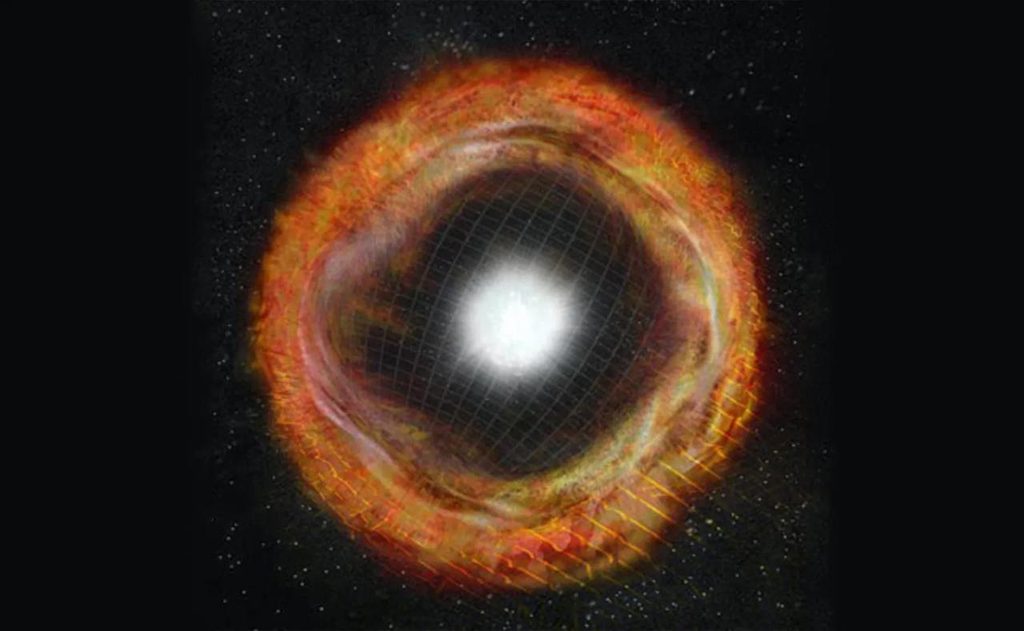
We will cover following things one by one to bring out the clarity:
- What is Supernova?
- What are Neutrinos?
- What is the role of Neutrinos (Ghost Particles) in supernova?
- What is Threshold limit (TOV limit) which decides whether the Supernova star turns into neutron star or a Black hole?
- What the new findings suggest?
1. What is Supernova?
Most of the stars use Hydrogen as their fuel to generate helium and massive amount of light and heat energy with the help of Nuclear fusion. At the end of its life cycle, a star runs out of its hydrogen fuel which suddenly stops the Nuclear fusion and stops the outward release of heat and light energy. The extreme gravity of its core forces outer layer as well as core itself to implode.
In this process, the core become so dense that it no longer get denser and the infalling outer layer and material starts to bounce back from the dense core. The bounced back material pushes the outer layer outward with such a huge amount of heat and pressure that it explodes the outer layer causing Supernova.
2. What are Neutrinos?
Neutrinos also known as Ghost Particles mainly because it passes through almost all matters unnoticed. Trillions of neutrinos passes through our body every second without being felt of.
There are three types of Neutrinos, which are also called flavor of Neutrinos:-
- Electron
- Muon
- Tau
Muon Neutrino and Tau Neutrino are less likely to interact with any matter when compared to Electron neutrino.
Source of Neutrino: when Protons and electrons are squeezed and fused together due to extreme gravitational pull it leads to the generation of neutron. And in this process neutrinos are released.
Proton+Electron-> Neutron+ve(electron Neutrino)
3. What is the role of Neutrinos in Supernova?
Neutrinos play a fundamental and dominant role in a supernova, serving as the primary engine that drives the visual explosion. Without them, the shock wave created by the collapsing core would stall, and the star would simply collapse quietly into a black hole without a bright explosion.
According to research from the Max Planck Institute for Astrophysics, neutrinos carry away 99% of the total energy released during a core-collapse supernova.
Their three critical roles during this event include:
- Re-energising the Stalled Shock Wave
When the iron core of a massive star collapses and rebounds, it creates a powerful shock wave that begins tearing outward through the star. However, as the shock wave plows through heavy infalling iron nuclei, it loses immense energy and stalls completely within milliseconds.
- The Neutrino Engine: The ultra-dense, newly formed proto-neutron star at the center begins radiating a colossal flood of neutrinos.
- The Revival: As these neutrinos stream outward, a small fraction (about 1%) are absorbed by the dense matter just behind the stalled shock wave.
- The Blast: This intense heating acts like a massive boiling pot, building up immense pressure that re-ignites the shock wave, successfully driving the spectacular visual explosion through the star’s outer layers.
- Cooling the Proto-Neutron Star
The remnant core left behind by the collapse is incredibly hot, reaching temperatures exceeding 100 billion kelvins.
- Because the core is so impossibly dense, light (photons) cannot escape; it would take thousands of years for photons to diffuse out.
- Neutrinos interact very weakly with matter, allowing them to escape the core in a matter of seconds. By streaming away rapidly, they act as the primary cooling mechanism, allowing the core to shed its extreme thermal energy and settle down to become a stable neutron star or black hole.
- Driving Cosmic Element Synthesis (Nucleosynthesis)
As the intense wind of neutrinos blasts through the outer layers of the star, it interacts with protons and neutrons. This neutrino-driven wind alters the neutron-to-proton ratio in the surrounding matter. This environment allows rapid nuclear reactions to occur, contributing to the creation of elements heavier than iron (such as silver, gold, and uranium) which are then blasted out into the universe to form future planets and life.
4. What is Threshold limit (TOV limit) which decides whether the Supernova star turns into neutron star or a Black hole?
Tolman-Oppenheimer-Volkoff limit is vitally important threshold which decides whether a supernova star turns out to be a Neutron star due to successful explosion or a Black hole due to failed explosion.
TOV limit sits at 2 to 2.3 Solar Masses.
- Below TOV limit, Quantum Physics wins over Gravity:
As we have discussed earlier that during core collapse (implosion), the infalling outer layer bounces back from the core and re-ignites the stalled shockwave and push back the infalling material and successfully explodes. Here the Quantum Physics (Neutron Degeneracy pressure-because of which material bounces back from the core) wins over the Gravity of core. - Above TOV limit, Gravity wins over Quantum Physics:
When the core’s mass exceeds the TOV limit i.e. 2 to 2.3 Solar mass, the gravitational pull of the imploding core is so powerful that it wins over the bouncing back pressure (Neutron degeneracy pressure-Quantum Physics). And hence instead of exploding, the gravity pulls everything and vanishes all the star’s material within seconds forming a Black hole.
5. What the new findings suggest?
We have understood the role of Neutrinos in re-igniting the stalled shockwave and pushing back the infalling outer layer of a star helping it to explode.
But the new findings have suggested that Neutrinos may not re-ignite the stalled shockwave and push back the infalling material even when the core’s mass is below TOV limit i.e. 2 to 2.3 solar mass. This is because of two reasons:-
- Neutrinos change their flavor from Electron to Muon or Tau and vice versa while disseminating.
- Muon and Tau neutrinos are less likely to interact with matters compared to Electron neutrinos. So it might be possible that Electron neutrinos change to Muon neutrinos while re-igniting the stalled shockwave and pushing back the infalling material. And this simply passes through the infalling material without interacting as Muon neutrinos are less likely to interact with the matter when compared to Electron neutrinos.
As per SPACE.COM portal, this finding has the potential to solve many mysteries regarding cosmic events. For instance, till now practically astronomers could identify fewer Supernovae than what theoretical simulations suggest.