
A 12-year mission to uncover the secrets of our solar system’s origins
On October 16, 2021, NASA launched Lucy, a spacecraft embarking on an extraordinary 12-year mission to explore primitive asteroids and investigate the origins of our solar system. Five years later, Lucy continues its remarkable journey, travelling through deep space towards some of the most ancient objects in our celestial neighbourhood: Jupiter’s Trojan asteroids.
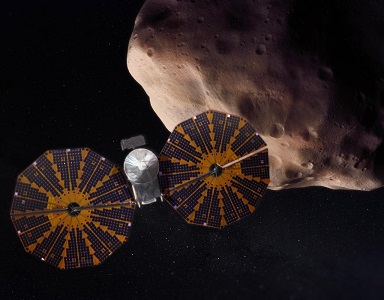
The spacecraft’s name has a fascinating story behind it. Lucy was named after the 3.2-million-year-old fossilised human ancestor, Lucy, while also paying tribute to the Beatles song Lucy in the Sky with Diamonds. The connection to the song is reflected in the mission’s diamond-shaped logo. Just as the ancient fossil helped scientists understand human origins, NASA’s Lucy aims to shed light on the building blocks of our solar system.
Five years into its groundbreaking mission, Lucy is cruising more than 550 million miles from Earth, heading towards Jupiter’s Trojan asteroids. These ancient space rocks share Jupiter’s solar orbit and hold vital clues about the formation and evolution of our early solar system.
But Lucy’s journey has not been without milestones. Before reaching the Trojan swarms, the spacecraft began its exploration with encounters in the main asteroid belt.
On November 1, 2023, Lucy flew past Dinkinesh, discovering that the asteroid has a small moon named Selam. This encounter added an important discovery to the mission’s growing scientific record.
The spacecraft continued its journey and completed a close flyby of another main-belt asteroid, Donaldjohanson, on April 20, 2025. Having completed flybys of these main-belt targets, Lucy is now preparing for the next major phase of its mission.
Its ultimate goal is to investigate a total of 11 asteroids: two main-belt asteroids and nine Jupiter Trojan asteroids, including additional targets identified along the way.
The next frontier: Jupiter’s Trojan asteroids
Lucy’s primary science phase will begin with its arrival at the Trojan asteroids, scheduled to take place between 2027 and 2033. These objects, trapped in Jupiter’s orbit, offer scientists an opportunity to investigate ancient material that may hold clues to the early solar system.
The planned encounters include:
- August 11, 2027: Eurybates and its moon Queta.
- September 14, 2027: Polymele.
- April 18, 2028: Leucus.
- November 11, 2028: Orus.
- March 3, 2033: Patroclus and Menoetius.
Each encounter will bring Lucy closer to its goal of studying these distant asteroids and understanding their composition, characteristics and significance in the history of our solar system.
Three instruments to unlock ancient secrets
To investigate these celestial objects, Lucy carries three main scientific instruments designed to study their surface geology, composition and thermal properties.
L’Ralph is a visible and infrared colour imager and spectrometer that will study surface composition and ices.
L’LORRI is a high-resolution telescopic camera designed to capture detailed images of asteroid structures.
L’TES is a thermal emission spectrometer that measures infrared energy to determine the physical properties of asteroid surfaces.
Working together, these instruments will help scientists examine the asteroids in detail and gather valuable information about these ancient objects.
A journey that continues to push boundaries
Lucy is travelling farther than any solar-powered probe before it, continuing to push the frontiers of deep-space exploration. Its journey represents a major effort to understand the primitive asteroids that preserve clues about the materials from which our solar system formed.
Five years after its launch, Lucy has already achieved important milestones, from its encounters with Dinkinesh and Donaldjohanson to its ongoing journey towards Jupiter’s Trojan swarms.
With its first Trojan rendezvous approaching in 2027, the spacecraft is preparing to explore a collection of ancient worlds that could help scientists better understand our cosmic past.
Lucy’s five-year milestone is not the end of the story. It is another step in a 12-year quest to uncover the secrets of the solar system’s origins.