
The dream of exploring the Moon is entering a new era, with private companies playing an increasingly important role in developing technologies for future lunar missions. One such initiative is the FLIP (FLEX Lunar Innovation Platform) mission, a commercial robotic lunar expedition developed by Venturi Astrolab. Designed as a technology testbed for the company’s larger FLEX rover, FLIP aims to demonstrate innovative engineering solutions that could support future lunar exploration, including NASA’s Artemis program.
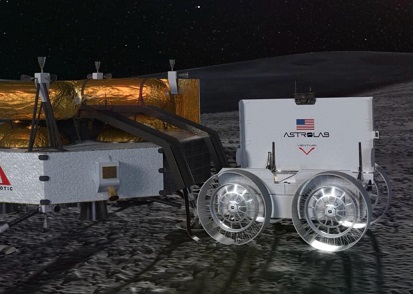
The mission has also taken on a significant role in lunar exploration plans by filling the slot on Astrobotic Technology’s Griffin-1 lunar lander that was originally intended for NASA’s now-cancelled VIPER rover. Through this mission, FLIP will help advance commercial lunar transportation and surface exploration technologies.
Preparing for the Lunar Journey
FLIP is designed to travel to the Moon aboard Astrobotic Technology’s Griffin-1 lander, which is part of NASA’s Commercial Lunar Payload Services (CLPS) program. Its journey to space is planned aboard a powerful SpaceX Falcon Heavy rocket, with a lunar landing scheduled for 2026.
The mission’s destination is the Nobile Region near Mons Mouton at the lunar South Pole. This region is of particular interest to lunar explorers because the South Pole offers opportunities to investigate the Moon’s geology, surface conditions, and resources that could prove valuable for future human missions.
With an estimated Earth mass of approximately 450 kilograms (1,000 pounds), FLIP is designed to carry up to 30 kilograms (66 pounds) of scientific instruments and commercial cargo. Despite its compact size, the platform is intended to support a wide range of experiments and demonstrate technologies needed for more ambitious lunar missions.
A Unique Rover Designed for the Moon
One of FLIP’s most distinctive features is its deployment mechanism. Rather than relying on a conventional ramp to leave the lander, the rover uses a specially designed mechanical flip or direct-transition maneuver to move onto the lunar surface. This unconventional approach highlights the mission’s emphasis on testing new engineering concepts.
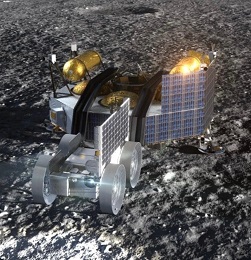
Its mobility system is equally innovative. FLIP features hyper-deformable mesh tires made from composite materials such as Nomex and Kevlar, combined with a metal-wire structure. These wheels have been developed with the involvement of strategic partner Venturi Space and are designed to address the challenges of traversing the Moon’s rugged terrain.
Powering the rover are collapsible solar arrays and high-performance batteries designed for demanding, cryogenic environments. These power systems are designed and manufactured in Monaco and Switzerland, reflecting the international expertise contributing to the mission.
Together, these components will provide an opportunity to test full-scale technologies, including batteries, wheels, actuators, avionics, sensors, and software. The knowledge gained will help refine systems intended for integration into the larger commercial FLEX rover and may contribute to technologies supporting NASA’s Artemis program.
Tackling Lunar Dust and Environmental Challenges
While the Moon may appear calm and lifeless, its surface presents serious engineering challenges. Lunar regolith—the layer of loose dust, soil, and fragmented rock covering the surface—is abrasive and can adhere to equipment, potentially affecting moving parts, sensors, and other critical systems.
One of FLIP’s important objectives is to collect engineering data on how lunar dust interacts with rover components and surface systems. Understanding these interactions will help engineers develop better ways to protect equipment and improve the reliability of future lunar vehicles and infrastructure.
The mission will also investigate local dust dynamics, surface perception, regolith composition, and the harsh environmental conditions found near the lunar South Pole. These studies will contribute to a better understanding of the operating conditions that future robotic and crewed missions will encounter.
Thirteen Payloads for Science and Innovation
Beyond testing rover technology, FLIP will serve as a flexible platform for scientific research and commercial experimentation. The mission is designed to host 13 distinct payloads, including instruments and experiments associated with four separate NASA centers.
These payloads will investigate different aspects of the lunar environment, from the composition and behavior of surface materials to the performance of sensors and other technologies under challenging conditions. The platform’s ability to accommodate multiple institutional, commercial, and research customers also demonstrates how commercial lunar missions can support a diverse range of scientific and technological goals.
Building the Foundation for Future Lunar Exploration
Ultimately, FLIP is about more than sending a small robotic platform to the Moon. It represents an important step toward developing reliable, commercially supported technologies for sustained lunar operations.
By testing advanced mobility systems, power solutions, sensors, software, and dust-mitigation approaches in the lunar environment, the mission aims to generate practical knowledge that can inform the design of larger rovers and future surface infrastructure.
As humanity prepares for more ambitious exploration of the lunar South Pole, missions such as FLIP demonstrate how commercial innovation, scientific research, and international engineering collaboration can work together. If successful, the mission will help lay the technological groundwork for the next generation of lunar vehicles and support the broader goal of making long-term exploration of the Moon more achievable.