
Nuclear Energy Mission for Viksit Bharat
Overall Mission Goals
- Target of 100 GWe nuclear power capacity by 2047 to support India’s Net Zero by 2070 goal.
- Aims to expand low-carbon, reliable base-load power, reducing dependence on fossil fuels.
- Focus on increasing nuclear energy’s share in India’s energy mix using indigenous technologies.
Two-Pronged Strategy for Capacity Expansion
- Large Reactors
- Deployment of 700 MWe indigenous PHWRs.
- Installation of large imported reactors at greenfield sites for rapid capacity addition.
- Small Modular Reactors (SMRs)
- BSMR-200 (200 MWe) and SMR-55 (55 MWe) designed by BARC.
- Intended for brownfield deployment with multiple applications:
- Repurposing retiring fossil-fuel plants.
- Serving captive power needs of energy-intensive industries (steel, aluminum, metals).
- Off-grid and remote area power supply.
- SMRs positioned as key solutions for decarbonising power, industrial processes, and transport.
R&D and Advanced Technologies
- Emphasis on indigenous advanced reactor designs, improved safety, and new fuel cycles.
- Development of high-temperature gas-cooled reactors (up to 5 MWth) for hydrogen production, enabling decarbonisation of transport and process industries.
Implementation and Demonstration Plans
- Lead units of BSMR-200, SMR-55, and high-temperature reactors to be constructed at DAE sites.
- Expected construction time: 60–72 months from sanction.
Current and Projected Nuclear Capacity
- Existing operational units include Kakrapar 3 & 4 (2×700 MW) and Rajasthan Unit-7 (700 MW).
- NPCIL targets:
- ~22 GW nuclear capacity by 2031–32.
- ~54 GW by 2047 (from the current 8.78 GW, excluding RAPS-1).
Uranium Resource Development
- As of September 2025, AMD has established 4,36,700 tonnes of in-situ U₃O₈ across 47 deposits in 11 states.
- Recent discovery: 28,637 tonnes U₃O₈ at Jaduguda North–Baglasai–Mechua, Jharkhand—an extension of the existing Jaduguda deposit.
Regulatory Oversight
- Atomic Energy Regulatory Board (AERB) monitors all radiological safety aspects in uranium mining and milling.
- New projects undergo multi-stage safety reviews following AERB and IAEA standards.
- Regular inspections ensure compliance with safety and waste-management norms.
Exercise Garuda-VIII (2025)
Exercise Overview
- 8th edition of Exercise Garuda, a bilateral Indo–French air exercise between the Indian Air Force (IAF) and the French Air and Space Force (FASF).
- Conducted at Air Base 118, Mont-de-Marsan, France.
- Exercise concluded on 27 November 2025; IAF contingent returned to India on 02 December 2025.
IAF Participation & Assets
- IAF deployed:
- Su-30MKI fighter aircraft
- IL-78 air-to-air refuelling aircraft
- C-17 Globemaster III transport aircraft
- Maintenance crews ensured high serviceability, enabling smooth execution of all planned missions.

Training Activities & Objectives
- Conducted complex air operations in a realistic operational environment.
- Activities included:
- Joint mission planning
- Coordinated strike and escort missions
- Familiarisation with each other’s operational procedures
- Focus on enhancing interoperability and operational coordination between the two air forces.
Engagements & Interactions
- Senior officials from India and France participated in the closing ceremony.
- They commended the forces for their professionalism, discipline, and commitment.
Significance
- One of the largest international air training engagements of the IAF in 2025.
- Reinforced the strategic partnership between India and France.
- Provided valuable operational insights to both air forces.
- Expected to enhance:
- IAF’s war-fighting capabilities
- Jointmanship with friendly foreign air forces
- Future cooperation in bilateral and multinational frameworks
Deep Ocean Mission
Deep Ocean Mission (DOM) includes two major verticals related to deep-sea exploration:
- Technological Advancements for Deep-Sea Mining and Crewed Submersibles
- Deep Ocean Survey & Exploration
India’s deep-seabed mineral exploration is conducted under contracts with the International Seabed Authority (ISA).
- 2002: Contract for polymetallic nodules (PMN) over ~75,000 km² in the Central Indian Ocean Basin (CIOB).
- 2016: Contract for polymetallic sulphides (PMS) over 10,000 km² in the Central Indian Ridge (CIR).
- 2025: Contract for PMS over 10,000 km² in the Carlsberg Ridge.
Exploration follows ISA-approved plans of work, which require:
- Seabed resource estimation
- Environmental baseline studies
- Geological, geophysical, oceanographic, and biological data collection
- Comprehensive biodiversity and ecosystem assessments
Regulatory framework within India’s jurisdiction:
- Governed by the Offshore Areas Mineral (Development and Regulation) Act (OAMDR), amended in August 2023.
- Applies to all offshore minerals except mineral oils and hydrocarbons.
- Supporting rules notified in 2024, including:
- Offshore Areas (Existence of Mineral Resources) Rules
- Offshore Areas Mineral (Auction) Rules
- Offshore Areas Operating Right Rules
- Offshore Areas Mineral Conservation and Development Rules
Beyond India’s EEZ, exploration in the Indian Ocean contract areas follows ISA regulations to ensure sustainable, legally compliant mineral exploration.
Passport Verification Records (PVR) on DigiLocker
- Initiative:
- NeGD (MeitY) in collaboration with MEA has enabled Passport Verification Records (PVR) on the DigiLocker platform.
- Part of the Digital India programme, aimed at secure, paperless, and citizen-centric service delivery.
- DigiLocker Overview:
- Cloud-based platform for issuance, storage, sharing, and verification of digital documents and certificates.
- Promotes paperless, contactless, and secure document management.
- Functionality for Citizens:
- PVRs can be accessed, stored, shared, and digitally verified within DigiLocker.
- Available in the “Issued Documents” section after verification.
- Can be accessed via web and mobile app.
- Key Benefits:
- Convenience & Anytime Access – Citizens can retrieve PVRs without physical copies.
- Faster Processes & Reduced Paperwork – Streamlines verification for travel, employment, and compliance.
- Secure & Tamper-Proof Records – Issued digitally by government systems; ensures authenticity and integrity.
- Easy Digital Sharing & Verification – Instant, consent-based sharing; reduces need for attested physical copies.
- Supports Paperless & Green Governance – Promotes environmentally responsible administrative practices.
- Significance:
- Modernizes citizen services and strengthens digital public infrastructure.
- Reinforces a ‘Citizen-First’ approach enhancing transparency and trust in government processes.
- Reflects a whole-of-government approach for secure and efficient digital service delivery.
- Expected to benefit millions of passport applicants and holders.
Analysis
- This initiative demonstrates India’s push towards digital governance, reducing reliance on physical documents.
- The integration of PVR with DigiLocker ensures security, authenticity, and convenience, aligning with global best practices in digital identity and document management.
- It enhances the usability of digital documents in multiple domains (government, travel, employment).
- The focus on citizen-centric design and eco-friendly governance aligns with India’s Digital India and sustainability goals.
Pradhan Mantri Kisan SAMPADA Yojana (PMKSY)
Scheme Overview:
- Pradhan Mantri Kisan SAMPADA Yojana (PMKSY) is a central sector, demand-driven scheme.
- Applications are invited from all eligible applicants, including Farmers Producing Organisations (FPOs).
- Expression of Interest (EoI) can be submitted from all over India, including Hazaribagh and Koderma districts in Jharkhand.
- Funds are not allocated or sanctioned state-wise under any PMKSY component.
Special Benefits for FPOs:
| Benefit | FPO Category | General Category / Others |
|---|---|---|
| Subsidy / Grant-in-Aid | 50% of eligible project cost; 70% under Food Safety & Quality Assurance | 35%; 50% under Food Safety & QA |
| Equity Contribution | 10% required | 20% required |
| Minimum Credit / Loan Requirement | 10% required | 20% required |
| Net Worth Requirement | Equal to grant-in-aid sought | 1.5 times the grant-in-aid |
Objective:
- To provide financial support and incentives to FPOs to enhance food processing infrastructure and quality assurance.
- Encourage inclusive participation of farmers’ groups in food processing and value addition.
Key Takeaways:
- FPOs are given preferential treatment in subsidy, equity, and loan requirements.
- Focus on ease of access to funds and financial viability for small and collective farmer organizations.
- Part of broader PMKSY goal to promote modern food processing and strengthen the supply chain in India.
PMFME Scheme (PM Formalisation of Micro Food Processing Enterprises)
Implementing Agency:
Ministry of Food Processing Industries (MoFPI); centrally sponsored scheme.
Objective:
- Support establishment and upgradation of micro food processing enterprises.
- Enhance competitiveness in the unorganized food-processing sector.
- Promote formalization of micro enterprises.
Type of Support Provided:
- Financial, technical, and business support for setting up or upgrading units.
- Credit-linked subsidy and other forms of assistance (details in the Annexure mentioned).
Beneficiaries Supported (as of 31 October 2025):
- 1,363 Self Help Groups (SHGs)
- 236 Farmer Producer Organisations (FPOs)
- 1,61,072 individual micro food processing enterprises
Promotion of “Vocal for Local”:
- Scheme adopts the One District One Product (ODOP) approach for balanced regional development.
- Each district selects one primary product for focused support, branding, and promotion.
- ODOP approved in 726 districts across 35 States/UTs, including GI-tagged products.
Key Contributions of the Scheme:
- Acts as a catalyst for rural economic growth and entrepreneurship.
- Enhances food security by reducing post-harvest losses, improving processing efficiency, and extending shelf life.
- Strengthens value chains via:
- District-specific ODOP interventions
- Technology adoption and capacity building
- Shared/common infrastructure for processing
- Market integration through e-commerce, retail, and institutional linkages
- Generates local employment, particularly through SHGs, FPOs, and community-based initiatives.
Groundwater Quality and Government Initiatives
Overall Groundwater Quality Status
- CGWB conducts groundwater quality monitoring and scientific studies as per a standardized SOP.
- Groundwater across India is largely potable, with localized contamination in isolated pockets.
Findings from Annual Ground Water Quality Report 2025
- In Katni district, Madhya Pradesh, all 16 monitored locations show Fluoride levels within the BIS permissible limit of 1.5 mg/L (IS 10500:2012).
- JJM data confirms no quality-affected habitations remaining in Katni district; safe drinking water has been ensured for all.
Groundwater Assessment in Other Districts
- In Panna and Khajuraho (Chhatarpur district), groundwater has been monitored for Fluoride, Arsenic, and Nitrate as per CGWB SOP.
- District-wise contamination details, including samples exceeding limits, are provided in the Annexure.
Responsibility and Governance
- Water is a State subject; primary responsibility for mitigation and provision of safe water lies with state governments.
- The Central Government complements these efforts through monitoring, policy support, and nationwide programs.
Key Central Government Interventions
- Enhanced Groundwater Monitoring
- CGWB adopted a new SOP with more frequent and denser sampling, especially in vulnerable areas.
- Quality data disseminated via Annual Reports, Half-yearly Bulletins, and Fortnightly Alerts for timely action.
- National Aquifer Mapping Programme (NAQUIM)
- Special focus on groundwater quality during aquifer mapping studies.
- Jal Jeevan Mission (JJM) – Har Ghar Jal
- Ensures contamination-free potable tap water to every rural household.
- Adopted BIS:10500 standards for tap water quality.
- Over 2,180 water quality testing laboratories established nationwide.
- States advised to set up Community Water Purification Plants (CWPPs) as interim solutions in affected areas.
- Artificial Recharge and Conservation Initiatives
- Programs such as Jal Shakti Abhiyan, Jal Sanchay Jan Bhagidari, Atal Bhujal Yojana, PMKSY, and MGNREGS help improve groundwater recharge and quality.
- Surface Water Pollution Control
- Since groundwater contamination is linked to polluted surface water, steps include installing STPs, ETPs, and improving sewage networks.
- Under NMCG and NRCP, substantial efforts are being made to improve water quality in major river stretches.
Jal Jeevan Mission (JJM) – Har Ghar Jal
Purpose and Implementation
- JJM – Har Ghar Jal is a centrally sponsored programme aimed at providing tap water supply to every rural household in all Gram Panchayats and villages across India.
- Implemented in partnership with States, as water is a State subject.
Community Participation and Governance
- In line with the 73rd Constitutional Amendment, the mission emphasizes village-level planning and community involvement.
- Gram Panchayats and their sub-committees like Village Water & Sanitation Committees (VWSCs)/Pani Samitis are empowered to:
- Plan
- Implement
- Manage
- Operate and maintain in-village water supply systems
- This strengthens ownership and accountability at the village level.
Certification of ‘Har Ghar Jal’ Status
- After achieving 100% tap connections in a village:
- Implementing department issues a completion certificate to the Gram Panchayat.
- Gram Panchayat, in a Gram Sabha meeting, reads out the completion report and passes a resolution certifying itself as a ‘Har Ghar Jal’ village.
- The certificate, Gram Sabha resolution, and a video of the Gram Sabha are uploaded to the JJM Dashboard.
- As of 02.12.2025:
- About 2.68 lakh villages have been reported as ‘Har Ghar Jal’.
- About 1.76 lakh villages have been certified by their Gram Sabhas.
Capacity Building – Nal Jal Mitra Programme (NJMP)
- To support local operation and maintenance, the Nal Jal Mitra Programme has been launched with the Ministry of Skill Development & Entrepreneurship.
- Trains community members as “Nal Jal Mitras” with skills such as:
- Masonry
- Plumbing
- Fitting
- Electrical work
- Motor mechanics
- Pump operations
- These trained individuals handle minor repairs, preventive maintenance, and functioning of piped water supply systems at the village level.
Indian Carbon Market under the Carbon Credit Trading Scheme (CCTS)
Institutional Framework
- The Carbon Credit Trading Scheme (CCTS) framework for the Indian Carbon Market has been finalized.
- Institutional structure includes:
- National Steering Committee co-chaired by Secretaries of the Ministry of Power and Ministry of Environment, Forest & Climate Change.
- Grid India designated as the Registry.
- Bureau of Energy Efficiency (BEE) designated as the Administrator.
Mechanisms under CCTS
- Compliance Mechanism
- Covers emission-intensive industries designated as Obligated Entities.
- These entities must meet assigned Greenhouse Gas Emission Intensity (GEI) targets.
- Entities that overachieve their targets earn Carbon Credit Certificates.
- Offset Mechanism
- Open to Non-Obligated Entities on a voluntary basis.
- Allows registration of projects that reduce, remove, or avoid GHG emissions.
- Such projects may receive Carbon Credit Certificates.
Sectoral Transition from PAT to CCTS
- The following sectors have shifted from the Perform, Achieve and Trade (PAT) scheme to the CCTS Compliance Mechanism:
- Aluminium
- Cement
- Chlor-alkali
- Petrochemicals
- Petroleum refineries
- Pulp & paper
- Textiles
- Thermal power plants have not been transitioned to the CCTS Compliance Mechanism.
CSIR Floriculture Mission
Objectives
- Enhance farmers’ income and livelihood security.
- Develop entrepreneurship in floriculture.
- Strengthen India’s domestic floriculture sector and reduce imports.
Key Achievements
- Phase II: Created 32,44,000 man-days of employment.
- Area under cultivation: 2,208.63 ha across 399 clusters in 126 districts of 26 States/UTs.
- Direct beneficiaries: 16,220 individuals, including women.
- Technology development: 17 technologies transferred to entrepreneurs and industries.
- Capacity-building: 144 training programs for 5,728 beneficiaries, including 1,615 women.
- Apiculture integration: 1,072 honey bee boxes distributed, benefitting 175 farmers.
- Income impact: ₹262 crore generated, ~₹1.18 lakh per farmer (2–3× increase over traditional crops).
- Employment generated: Over 44 lakh man-days.
- Variety development: Eight flower varieties released (lotus, chrysanthemum, gerbera).
Export & Import Impact
- Targeted 15% reduction in flower imports.
- Strengthened domestic flower production.
CSIR Aroma Mission
Objectives
- Promote rural empowerment through aromatic crop cultivation, processing, and value addition.
- Support aroma industry with quality raw materials and contribute to self-reliance.
Key Achievements
- Area covered: Over 51,000 ha under aromatic crops.
- Clusters developed: 4,500+ clusters across 28 States, including 20 tribal clusters.
- Technology & varieties: 52 varieties and 82 region-specific agro-technologies developed.
- Processing infrastructure: 408 improved distillation units installed.
- Skill development: 2,096 training programs, trained 1.22 lakh manpower including 10,000 women.
- Entrepreneur support: 110+ entrepreneurs assisted in value-added products.
- Employment created: ~1 crore rural jobs.
- Production & revenue: 6,000+ tons of essential oils worth ₹600 crore.
Crop Benefits
- Aromatic crops like Lemongrass, Palmarosa, Vetiver, Tulsi, and Mentha:
- Low water and nutrient requirements.
- Suitable for rain-fed conditions.
- Income: ₹60,000–₹70,000 per hectare.
- Vetiver cultivation profitable in disaster-affected areas (cyclones, floods).
Export & Self-reliance Impact
- India became largest producer and exporter of lemongrass oil.
- Leadership in Menthol Mint production.
- Vetiver cultivation in UP, Bihar, Tamil Nadu reduced import dependence.
- Palmarosa oil exported to multiple countries.
Combined Socio-Economic Impact
- Both missions have significantly enhanced farmers’ income, livelihoods, and employment.
- Developed high-yielding crop varieties for domestic cultivation and export.
- Promoted rural entrepreneurship, capacity-building, and technology transfer.
Nano-plastics from PET Bottles – Key Findings
Background
- Nano-plastics are emerging pollutants detected in the human body, but their direct effects on human health were poorly understood.
- Gut microbes play a central role in immunity, metabolism, and mental well-being, making them critical to study in the context of nano-plastic exposure.
Research Study
- Conducted by Institute of Nano Science and Technology (INST), Mohali under Department of Science and Technology (DST).
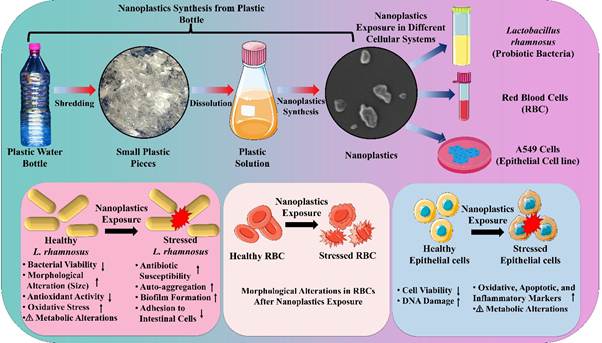
- Objective: Investigate the impact of nano-plastics on multiple biological systems – gut bacteria, red blood cells, and human epithelial cells.
- Method: Nano-plastics recreated from PET bottles in the laboratory and tested across three biological models.
Findings
- Gut Bacteria (Lactobacillus rhamnosus)
- Long-term exposure reduced bacterial growth, colonization, and protective functions.
- Increased stress responses and higher sensitivity to antibiotics.
- Red Blood Cells
- High concentrations disrupted cell membranes.
- Caused hemolytic changes, affecting blood stability.
- Human Epithelial Cells
- Prolonged exposure caused DNA damage, oxidative stress, and apoptosis.
- Triggered inflammatory signaling and altered energy and nutrient metabolism.
Implications
- Nano-plastics act as biologically active particles affecting gut health, blood stability, and general cellular function.
- Highlight hidden health risks from everyday plastics in food, water, and human body.
- Findings may inform industry practices and policy towards safer and sustainable plastic use.