
National Supercomputing Mission (NSM)
Vision and Objective
- Launched to achieve self-reliance in supercomputing in India.
- Focuses on:
- Providing access to state-of-the-art supercomputing facilities for researchers, academia, and startups.
- Indigenous manufacturing of critical sub-components for supercomputers.
Mission Overview
- Launch: April 2015
- Outlay: ₹4,500 crore
- Implementation: Jointly by MeitY and DST through C-DAC (Pune) and IISc (Bengaluru).
Deployment and Utilization
- 37 supercomputers deployed so far, totaling 40 Petaflops computing power.
- 34 supercomputers deployed in the last 5 years.
- 6 new systems under deployment with an outlay of ₹680 crore.
- Locations include IISc, IITs, C-DAC, R&D labs, and Tier-II/III cities.
- PARAM Rudra series: Supercomputers built with:
- Indigenously designed Rudra servers
- Indigenous system software stack
- Usage:
- >13,000 researchers, including 1,700+ PhD scholars.
- >1 crore compute jobs completed.
- >1,500 research papers published.
- Active areas: Drug discovery, disaster management, energy security, climate modelling, astronomy, computational chemistry, fluid dynamics, materials research, aerospace engineering, etc.
- Startups and MSMEs also leveraging HPC for projects.
Indigenous Development & Technological Achievements
- Rudra Server Board:
- Designed and developed by C-DAC.
- Technology transferred to 3 Indian EMS partners for local manufacturing.
- High-speed inter-node communication:
- Speeds of 40 Gbps and 100 Gbps for efficient data transfer.
- Cooling technology:
- Fully indigenously developed and in deployment stage.
- HPC system software stack:
- Completely developed and integrated with supercomputers.
- PARAM Shavak:
- A “supercomputing-in-a-box” for students and researchers.
- HPC Applications of National Importance:
- Developed for domains like genomics, drug discovery, flood forecasting, disaster management, urban weather modeling, seismic data processing, and material science.
- Integrated with end-users such as IMD, ONGC, CWC, CPCB, Ministry of Ayush.
- Future indigenous initiatives:
- Design and development of HPC processors, accelerators, and storage systems.
Key Impact
- NSM has established a complete supercomputing ecosystem in India.
- Strengthens India’s research capabilities, technological independence, and global competitiveness in high-performance computing and AI.
Sujalam Bharat App
Overview and Purpose
- Launched by: Union Minister of Jal Shakti, Shri C.R. Patil
- Objective: Transform rural drinking water governance using real-time digital data.
- Key Goal: Improve transparency, community ownership, and efficient management of rural water supply under Jal Jeevan Mission.
- Developed by: Bhaskaracharya National Institute for Space Applications and Geo-informatics (BISAG-N).
- Focus: Advanced geo-referencing, monitoring, and management of water supply infrastructure.
Key Features
- Sujalam Bharat Database
- Centralized platform integrating:
- Water sources
- Asset inventories
- Scheme designs
- Operational records
- Water quality reports
- Supply metrics
- Community feedback
- Centralized platform integrating:
- Sujal Gaon ID
- Each rural scheme and habitation assigned a unique ID.
- Enables clear mapping of which scheme supplies water to which households.
- Digital Profiling for Villages
- Drinking water source (local/bulk)
- Infrastructure condition and nature
- Supply reliability
- Water quality status
- O&M arrangements
- Promotes transparency and community oversight of Gram Panchayats/VWSCs and service providers.
Implementation and Training
- Nationwide online participation from all States and Union Territories.
- Hands-on training provided by BISAG-N for:
- Operational use of the app
- Geo-referencing procedures
- Integration of rural water assets into the system
- Encourages structured adoption of digital operations at state and district levels.
Integration and Long-Term Planning
- Integration with PM Gati Shakti GIS for geospatial mapping of water networks.
- Maintains historical records of infrastructure, maintenance, and service levels.
- Supports future planning, repair, and expansion with precision.
- Aims to create a secure, reliable, and technology-enabled rural drinking water ecosystem.
Significance
- Promotes citizen-centric service delivery.
- Establishes Sujal Gaon ID as the “Aadhaar of rural water management”.
- Ensures sustainable and accountable water supply for every household.
- App will soon be available on Google Play Store for download.
MoU between Ministry of Labour & Employment and Microsoft
Overview
- Signatories: Ministry of Labour & Employment and Microsoft
- Key Officials:
- Dr. Mansukh Mandaviya – Union Minister for Labour & Employment & Youth Affairs & Sports
- Satya Nadella – CEO, Microsoft
- Location: New Delhi
- Purpose: Expand employment linkages, AI-led skilling, and prepare India’s workforce for global opportunities.
Key Features of the Collaboration
- Integration with National Career Service (NCS)
- Microsoft to encourage 15,000+ employers and partners from its global network to join the NCS platform.
- Aim: Broaden formal job access, support high-growth sectors, and enable international mobility of Indian professionals.
- AI-driven Skilling Initiatives
- Expansion of DigiSaksham to equip millions of youth with future-ready skills in:
- AI
- Cloud technologies
- Cybersecurity
- Productivity tools
- Supports alignment with global industry standards.
- Expansion of DigiSaksham to equip millions of youth with future-ready skills in:
- Employment Digital Public Infrastructure (Employment DPI)
- Microsoft to support development of interoperable solutions for labour markets at scale.
- Leverages Microsoft’s Azure and AI capabilities for strengthening NCS, e-Shram analytics, and labour market intelligence.
- Social Protection Integration
- India’s social protection coverage rose from 19% in 2015 to 64.3% in 2025, benefiting over 94 crore citizens.
- AI integration into e-Shram and NCS platforms strengthens social security and moves toward the goal of 100 crore citizens by March 2026.
- Recognized by Microsoft as a benchmark for worker-centric policies using real-time data.
- Employer & Partner Outreach
- Microsoft’s partner ecosystem to enhance employer engagement, NCS adoption, and reach among industry, training partners, and institutions.
Significance
- Strengthens India’s workforce globally by improving digital skills and AI competencies.
- Expands formal employment opportunities via NCS.
- Reinforces social protection and policy design through AI-driven labour market intelligence.
- Positions India as a global leader in employment digital infrastructure.
Indian Railways Hydrogen Train Project
Overview
- Purpose: Pilot project to demonstrate the use of hydrogen-powered train technology in India.
- Development Agency: Research, Design & Standards Organization (RDSO) framed the specifications; Indian Railways executed the project.
- Location of Hydrogen Plant: Jind, Haryana.
- Hydrogen Production: Using electrolysis, a green hydrogen generation process.
Key Features of the Hydrogen Train-set
- Indigenous Development
- Designed and developed entirely in India, showcasing Atmanirbhar Bharat initiative.
- Train Specifications
- World’s longest hydrogen train on broad gauge: 10 coaches.
- Power: 2400 kW total (two Driving Power Cars (DPCs) of 1200 kW each).
- Passenger coaches: 8.
- Zero CO₂ emissions: Only water vapor is emitted.
- Significance
- Major milestone in next-generation fuel technology for railways.
- Covers designing, prototyping, and first-time development of hydrogen traction technology.
- Provides a pilot-scale demonstration; cost comparisons with conventional traction are not yet meaningful.
- Environmental Impact
- Supports cleaner and greener transportation.
- Aligns with India’s commitment to sustainable and alternative energy sources.
- Strategic Importance
- Demonstrates Indian Railways’ commitment to innovation in alternative energy-powered mobility.
- Paves the way for future hydrogen-based train travel in India.
Deodar Trees and Himalayan Geohazards
Location & Context
- Site: Batseri, a village in Sangla valley, Kinnaur district, Himachal Pradesh.
- Geographical Feature: Along the Baspa River, in the western Himalayas.
- Problem: Increasing frequency of extreme climatic events like droughts and floods linked with geohazards (landslides, rockfalls, GLOFs, snow avalanches).
Objective of the Study
- To reconstruct past hydroclimatic conditions and understand their link with geohazard events.
- To support future risk assessment and early warning systems in the Himalayan region.
- Conducted by Birbal Sahni Institute of Palaeosciences (BSIP), an autonomous institute under DST.
Methodology
- Tree-ring analysis (Dendroclimatology & Dendrogeomorphology):
- Deodar (Cedrus deodara) trees act as natural archives, recording climate and geohazard events over centuries.
- 378-year reconstruction (1558–2021 CE): Spring moisture history.
- 168-year record (1853–2021 CE): Rockfall activity.
- Key Focus:
- Spring months (February–April) moisture, influenced by Western Disturbances (WDs).
- Correlation between dry springs and rockfall events.
Key Findings
- Shift from wetter conditions during Little Ice Age to progressive drying after 1757 CE.
- 53 rockfall events recorded; 8 of high intensity, mostly linked to spring droughts, especially after 1960.
- Mechanism:
- Dry spring → poor slope vegetation → high vulnerability → heavy summer monsoon → rockfalls/landslides.
- Climate variability plays a critical role in triggering geohazards in the Himalayas.
Significance
- Provides high-resolution long-term records of hydroclimatic and geohazard events.
- Supports forest management, slope stabilization, and early warning systems.
- Helps local communities and policymakers plan sustainable land-use and disaster preparedness.
- Enhances understanding of climate-geohazard interactions, crucial for adaptation to climate change.
Publication
- Published in the journal Catena.
GlowCas9: A Breakthrough in Real-Time Gene Editing Visualization
Background
- CRISPR-Cas9 is a revolutionary gene-editing tool that cuts DNA at precise locations using a guide RNA.
- Traditional methods cannot observe Cas9 inside living cells in real time; they require fixing or lysing cells.
- Real-time monitoring is essential for understanding gene-editing dynamics and ensuring safety, precision, and effectiveness in gene therapy.
New Breakthrough: GlowCas9
- Scientists at the Bose Institute, Kolkata (DST) developed GlowCas9, a Cas9 enzyme that emits light while editing genes.
- Led by Dr. Basudeb Maji, with PhD researcher Arkadeep Karmakar designing the protein.
How GlowCas9 Works
- GlowCas9 is a bioluminescent Cas9 enzyme created by fusing Cas9 with split nano-luciferase, derived from deep-sea shrimp.
- The two inactive enzyme fragments reassemble only when Cas9 folds correctly, producing a visible glow—like firefly light.
- This allows non-destructive, real-time tracking of gene editing inside:
- Living cells
- Whole tissues
- Even plant leaves
Advantages of GlowCas9
- Real-time monitoring of CRISPR activity — “theratracking,” a new direction in visual gene therapy.
- High stability — retains its structure and activity even at elevated temperatures.
- Improves precision of Homology-Directed Repair (HDR) used to correct hereditary mutations (e.g., sickle cell anemia, muscular dystrophy).
- Safer delivery for gene therapy due to enhanced enzyme robustness.
- Works in plant systems → potential for non-transgenic crop improvement.
Symbolic Demonstration
- Researchers programmed GlowCas9 to insert the DNA sequence spelling “ACHARYA” into the genome—honoring J.C. Bose, founder of the Bose Institute.
- Demonstrates the enzyme’s high precision in targeted gene insertion.
Significance
- Opens new possibilities for visualizing genetic edits as they occur.
- Helps scientists understand:
- How gene editing unfolds in real time
- When and where repairs occur
- Whether edits are precise and successful
- Advances gene therapy toward becoming safer, more controlled, and more transparent.
Indian Navy’s DSC A20 Diving Support Craft
Commissioning Details
- The Indian Navy will commission DSC A20—the first vessel in the Diving Support Craft (DSC) class—on 16 December 2025 at Kochi.
- The commissioning will occur under the Southern Naval Command, with Vice Admiral Sameer Saxena presiding.
- The induction strengthens the Navy’s operational capability in underwater and diving operations.
Construction & Indigenous Development
- DSC A20 is the lead ship in a series of five indigenously designed and built Diving Support Crafts.
- Built by Titagarh Rail Systems Limited (TRSL), Kolkata.
- Represents a major achievement for Aatmanirbhar Bharat and the Make in India initiative in the maritime sector.
- Developed through collaboration among:
- Indian Navy
- Indigenous shipbuilders
- National R&D agencies like NSTL (Naval Science and Technological Laboratory)
Design & Technical Features
- Catamaran hull form for:
- Superior stability
- Larger deck area
- Improved seakeeping
- Displacement: Approx. 390 tons.
- Equipped with advanced, state-of-the-art diving systems for multiple underwater missions.
- Designed and constructed under the Indian Register of Shipping (IRS) Naval Rules.
- Underwent hydrodynamic modelling and testing at NSTL, ensuring high performance and reliability.
Operational Capabilities
DSC A20 is purpose-built for:
- Diving support operations
- Underwater inspection
- Salvage assistance
- Coastal deployment and underwater missions
- General maritime support in shallow and coastal waters
The vessel will be based at Kochi and operate under the Southern Naval Command.
Strategic Significance
- Enhances the Indian Navy’s underwater operational readiness.
- Adds a critical asset for coastal security and underwater maintenance.
- Strengthens India’s indigenous shipbuilding ecosystem and maritime self-reliance.
e-Courts Project Phase-III
1. Financial Outlay & Expenditure
- Total outlay for e-Courts Project Phase-III: ₹7,210 crore over four years.
- Expenditures:
- ₹768.25 crore in FY 2023-24
- ₹1,029.11 crore in FY 2024-25
- ₹907.97 crore released in FY 2025-26 (current year)
2. Vision & Objectives
- Transform Indian courts into digital and paperless courts.
- Digitization of legacy and current case records.
- Expansion of video conferencing across all courts, jails, and selected hospitals.
- Expansion of online courts beyond traffic violations.
- Universal rollout of e-Sewa Kendras.
- Creation of cloud-based national data repository for digitized court records.
- Use of AI and OCR technologies for case analysis, forecasting, and document processing.
- Deployment of Digital Courts 2.1, enabling judges to access all digital case documents, evidence, and filings.
3. Key Achievements Under Phase-III
Digital Infrastructure
- 99.5% of court complexes connected through WAN (10–100 Mbps bandwidth).
- Case Information System (CIS) 4.0 implemented in all courts.
- Digital courts generating:
- 4+ lakh SMS/day, 6+ lakh emails/day
- 35 lakh daily hits on e-Courts portal
- 14+ crore SMS to litigants and advocates so far
Virtual Courts & Online Adjudication
- 29 Virtual Courts operational (as of 30.09.2025).
- Received 8.96 crore challans:
- 7.84 crore challans disposed.
- 86.59 lakh challans paid.
- Payments amounting to ₹895.59 crore collected.
Digital Services for Citizens
- e-Courts Mobile App:
- 3.38 crore downloads; provides case status, cause lists, orders.
- JustIS App:
- 21,955 downloads; enables judges to monitor judicial work.
- e-Sewa Kendras:
- 1,987 centres operational for citizen/legal service facilitation.
Digitization of Records
- High Courts have digitized 224.66 crore pages.
- District Courts have digitized 354.87 crore pages.
Video Conferencing & Online Hearings
- VC facilities available in 3,240 courts and 1,272 jails.
- 3.81 crore online hearings conducted (till 30.09.2025).
- Live streaming currently active in 11 High Courts.
e-Filing & e-Payments
- 5,187 court establishments enabled on e-Filing portal.
- 92.08 lakh cases e-filed (till 30.09.2025).
- e-Payments system:
- 49.2 lakh court-fee transactions worth ₹1,215.98 crore.
- 4.86 lakh fine payments worth ₹61.97 crore.
Solar Power & Infrastructure Support
- Solar systems installed in 1,471 out of 1,530 targeted courts.
Process Automation
- Under NSTEP (National Service and Tracking of Electronic Processes):
- 6.21 crore e-processes issued.
- 1.61 crore e-processes successfully delivered.
Digital Platforms & Repositories
- Judgment Search Portal hosts 1.69 crore judgments.
- S3WaaS platform hosts 730 District Court websites.
- Pilot testing of Digital Courts 2.1 underway.
4. Innovations Under ICJS & Additional Platforms
- Nyaya Shruti App (2024):
- Enables virtual appearances of accused, witnesses, police, prosecutors, experts, and prisoners.
- 17 High Courts have notified Nyaya Shruti Rules for integration.
- e-Sakshya Platform:
- Facilitates digital recording of evidence for accuracy and transparency.
- e-Summons Platform:
- Ensures faster and more reliable delivery of summons and notices.
5. Capacity Building & Training
- Out of ₹7,210 crore, ₹208.52 crore earmarked for training and change management.
- 6-tier training model: national, state, regional levels.
- 910 training programmes conducted.
- 3,22,740 stakeholders trained, including:
- Judges and court staff
- Technical personnel
- Specialised training for visually challenged officers
- Training in cybersecurity and digital forensics
6. Overall Impact
- Rapid progress towards paperless, transparent, and digitally integrated courts.
- Enhanced access to justice through:
- e-filing
- online hearings
- virtual courts
- digital evidence
- real-time case information
- Improved efficiency, reduced dependency on physical infrastructure, and faster case processing.
Field Trials Hydrogen Fuel Cell Electric Vehicle (FCEV)
1. Launch of Pilot Project
- Union Minister for New & Renewable Energy Shri Pralhad Joshi launched the Pilot Project for field trials on the use of hydrogen in the mobility sector.
- Described as a major milestone in India’s clean and green energy transition.
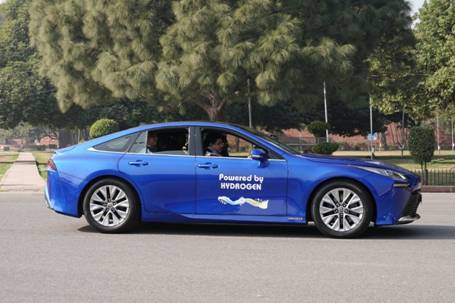
- Toyota’s Mirai hydrogen fuel cell electric vehicle (FCEV) handed over to NISE for real-world testing.
2. Importance of Green Hydrogen
- Green hydrogen highlighted as the backbone of future global energy systems.
- Supports India’s goals of:
- Energy Aatma Nirbharta
- Innovative low-emission transport
- Achievement of Panchamrit climate commitments
- Government confident that green hydrogen will play a central role in India’s future energy economy.
3. Significance of Toyota ‘Mirai’
- ‘Mirai’ means “Future” in Japanese, symbolising sustainable mobility aspirations.
- Represents a new chapter in India’s clean transportation ecosystem.
- FCEVs emit only water, producing zero pollution.
4. Role of NISE (National Institute for Solar Energy)
- Under the MoU, NISE will conduct a two-year comprehensive test of the Mirai FCEV.
- Testing will consider heat, dust, heavy traffic, varied terrain, and other Indian conditions.
- Aims to build industry confidence, develop technical capability, and generate insights for scaling hydrogen mobility.
5. Statements Highlighting the Project’s Importance
Shri Pralhad Joshi
- Personally drove the hydrogen vehicle to send a message that hydrogen mobility is ready for India.
- Praised Toyota Kirloskar Motor for its commitment to carbon neutrality.
- Appreciated NISE for leadership in clean energy advancements.
- Described the initiative as launching confidence, cooperation, and commitment for a sustainable future.
Shri Shripad Yesso Naik (MoS, MNRE)
- Called the project a major step toward clean, green, self-reliant energy.
- Linked it to India’s progress under the National Green Hydrogen Mission (2023).
- Stated that real-world testing marks India’s progress from policy to experimentation to commercialization.
- Emphasized the strong collaboration between government, research institutions, and industry.
Toyota Kirloskar Motor (TKM)
- Reaffirmed dedication to the National Green Hydrogen Mission.
- Stressed hydrogen fuel-cell tech as vital for net-zero targets and energy independence.
6. About Toyota Mirai FCEV
- Second-generation hydrogen fuel-cell electric vehicle.
- Produces electricity from a chemical reaction between hydrogen and oxygen.
- Emits only water vapour → 100% clean.
- Driving range: ~650 km
- Refuelling time: Under 5 minutes
- Considered one of the most advanced zero-emission vehicles globally.
India’s first fully indigenous hydrogen fuel cell passenger vessel
1. Historic Launch
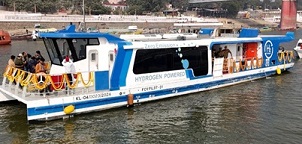
- Union Minister for Ports, Shipping and Waterways Sarbananda Sonowal flagged off India’s first fully indigenous hydrogen fuel cell passenger vessel at Namo Ghat, Varanasi.
- Marks a major milestone in India’s green maritime initiatives and clean mobility transition.
2. Technological Significance
- First vessel in India to demonstrate hydrogen fuel cell propulsion in a maritime setting.
- Powered by a Low Temperature Proton Exchange Membrane (PEM) fuel cell system.
- Converts stored hydrogen into electricity, emitting only water, ensuring zero pollution.
- Based entirely on indigenous technology, strengthening “Make in India”.
3. Leadership & Vision
- Minister Sonowal highlighted the launch as aligned with PM Narendra Modi’s vision of:
- Clean, sustainable, self-reliant transportation
- Green mobility across all sectors
- Preservation and rejuvenation of the Ganga
- Supports India’s commitment to net-zero emissions by 2070.
4. Organisations Involved
- Owned by: Inland Waterways Authority of India (IWAI)
- Built by: Cochin Shipyard Ltd (CSL)
- Vessel introduced after completion of successful trial operations.
- Supports initiatives under:
- Maritime India Vision 2030 (MIV 2030)
- Maritime Amrit Kaal Vision 2047 (MAKV 2047)
5. Vessel Specifications
- 24-meter catamaran, designed for urban transit.
- Fully air-conditioned cabin; 50-passenger capacity.
- Speed: 6.5 knots service speed; 7–9 knots possible.
- Operates for up to 8 hours on a single hydrogen fill.
- Hybrid system integrates hydrogen fuel cells + batteries + solar energy.
- Certified by: Indian Register of Shipping.
6. Tripartite Agreement for Operations
- Agreement signed between:
- IWAI
- Cochin Shipyard Ltd (CSL)
- Inland and Coastal Shipping Ltd
- Covers:
- Technical support
- Safety procedures
- Financial terms
- Monitoring & inspections during pilot phase
7. Benefits & Impact
- Provides noise-free, smoke-free, and zero-emission transportation.
- Reduces road congestion by promoting water-based mobility.
- Boosts:
- Local tourism
- Employment opportunities
- Clean urban transport
- Positions Varanasi among the first cities globally to adopt hydrogen-powered passenger vessels.
8. Maiden Voyage
- First commercial journey covered 5 km from Namo Ghat to Lalita Ghat.
- Carried ministers, senior officials, and dignitaries marking the start of commercial operations on National Waterway-1 (Ganga).
9. Broader Strategic Importance
- Reinforces IWAI’s long-term strategy to modernise and decarbonise India’s inland water transport network.
- Complements the earlier deployment of hybrid electric catamarans.
- Represents a critical step toward green, energy-efficient, and environmentally responsible maritime transport.