DRDO has successfully completed the User Evaluation Trials (UET) of the Next Generation Akash (Akash-NG) missile system.
UET is a critical phase that validates the system’s performance under realistic operational conditions by the end user (IAF).
Operational Performance
Missiles demonstrated high accuracy by intercepting aerial targets at:
Near-boundary, low-altitude scenarios
Long-range, high-altitude scenarios
Confirms Akash-NG’s capability to address diverse and complex aerial threats.
Technological Advancements
Equipped with an indigenous Radio Frequency (RF) seeker, enhancing target tracking and engagement accuracy.
Uses a solid rocket motor, ensuring reliability, quick response, and reduced maintenance.
Represents a significant upgrade over earlier Akash variants.
Indigenous Development & Industry Participation
All major systems and sub-systems—such as:
Multi-Function Radar (MFR)
Command and Control Unit
Missile Launch Vehicle (MLV)
Designed and developed by DRDO laboratories with support from Indian defence industries, strengthening Aatmanirbhar Bharat in defence.
User Involvement
Trials were witnessed by:
Senior DRDO scientists
Indian Air Force (IAF) user representatives
Ensures that operational requirements of the armed forces are fully met.
Strategic Significance
Akash-NG enhances India’s layered air defence architecture.
Improves the IAF’s ability to counter enemy aircraft, drones, and other aerial threats.
Boosts India’s preparedness along border and high-altitude regions.
Official Recognition & Statements
Raksha Mantri Rajnath Singh praised DRDO, IAF, and industry partners for the achievement.
Highlighted that Akash-NG will significantly strengthen India’s air defence capabilities.
Secretary (Defence R&D) and Chairman, DRDO confirmed that successful UET clears the way for induction into the Indian Armed Forces.
Outcome & Way Forward
Completion of UET marks the final step before induction.
Akash-NG is now ready for operational deployment, reinforcing India’s defence modernization and self-reliance.
INSV Kaundinya
Maiden Overseas Voyage
INSV Kaundinya, a stitched sailing vessel of the Indian Navy, will begin her maiden overseas voyage on 29 December 2025.
The vessel will be flagged off from Porbandar, Gujarat, to Muscat, Oman.
The voyage symbolically retraces ancient maritime trade routes linking India with the Indian Ocean world.
Historical & Cultural Significance
The vessel revives India’s ancient shipbuilding and seafaring traditions, highlighting the country’s historic maritime heritage.
Reflects India’s long-standing role as a maritime civilisation engaged in trade with West Asia, Africa, and Southeast Asia for millennia.
Traditional Shipbuilding Technique
Constructed entirely using the stitched-plank technique, an ancient method once prevalent along Indian coasts.
Wooden planks are stitched with coconut coir rope instead of metal fasteners.
Sealed using natural resins, ensuring flexibility and seaworthiness.
This technology enabled ancient Indian mariners to undertake long-distance oceanic voyages before modern metallurgy and navigation tools.
Design Inspiration & Craftsmanship
Inspired by depictions of ancient Indian ships found in historical sources.
Represents a convergence of history, traditional craftsmanship, and modern naval expertise.
Built by traditional artisans under the guidance of master shipwright Shri Babu Sankaran.
Institutional Collaboration
Project executed under a tripartite MoU involving:
Ministry of Culture
Indian Navy
M/s Hodi Innovations
Part of India’s broader effort to rediscover and revive indigenous knowledge systems.
Research & Technical Support
Supported by extensive research, design, and testing conducted by:
Indian Navy
Academic and research institutions
Despite traditional construction methods, the vessel is fully seaworthy and capable of oceanic navigation.
Name & Symbolism
Named after Kaundinya, a legendary ancient Indian mariner believed to have sailed from India to Southeast Asia.
Symbolises India’s historic maritime outreach and cultural exchange across the Indian Ocean.
Strategic & Soft Power Dimensions
Enhances India’s maritime cultural diplomacy through heritage-based naval initiatives.
Reinforces India’s image as a historically connected Indian Ocean power.
Aligns with national initiatives promoting heritage conservation, cultural revival, and naval outreach.
PESA Mahotsav 2025
Event Overview
The two-day PESA Mahotsav (23–24 December 2025) commenced in Visakhapatnam, Andhra Pradesh.
The event celebrates the Panchayats (Extension to Scheduled Areas) Act, 1996 (PESA), which strengthens self-governance in Scheduled Areas.
Inaugural PESA Run
The Mahotsav began with a PESA Run along Ramakrishna (R.K.) Beach, symbolising public participation and awareness.
The run saw enthusiastic participation from all age groups, with notable involvement of tribal youth.
Flagged off by Arjuna Awardee and renowned archer Ms. Jyothi Surekha Vennam.
Senior officials from the Ministry of Panchayati Raj (MoPR) and the Government of Andhra Pradesh were present.
Key Messages Highlighted
Speakers emphasised the spirit of PESA in:
Empowering Gram Sabhas
Protecting tribal rights
Safeguarding community resources
Preserving cultural identity of Scheduled Area communities
Formal Inauguration & Day-One Activities
The Mahotsav was formally inaugurated by senior officials from MoPR and Panchayat Raj & Rural Development Department, Andhra Pradesh.
A range of activities were organised to promote tribal culture and livelihoods:
Exhibition stalls, including a Craft Bazaar and Food Festival, showcasing tribal handicrafts and cuisines
Sports competitions such as Kabaddi and Archery
Kabaddi semi-finals held
Archery competitions conducted through multiple stages (qualifying to medal rounds)
Tribal Demo Games
The second half of Day One featured Tribal Demo Games by teams from various PESA States.
Traditional indigenous games showcased included:
Cholo, Yedu Penkulata, Gedi Doud, Rasa Kashi, Uppanna Barelu
Pithool, Sikor, Mallakhamba, Chakki Khel
These games reflected the rich sporting and cultural heritage of tribal communities.
Parallel Gram Sabha Activities
Gram Sabhas were conducted in 10 PESA Gram Panchayats in Alluri Sitharama Raju District.
Key discussion themes included:
Strengthening Gram Sabha institutions
Prevention of land alienation
Ownership and management of Minor Forest Produce (MFP)
Control over minor minerals and minor water bodies
Regulation of intoxicants and money lending
Preservation of customs, traditions, and cultural identity
Day Two Agenda & Significance
The Mahotsav will conclude with:
Technical sessions
Launch of landmark initiatives
Cultural programmes
Prize distribution and valedictory sessions
The event marks PESA Day, reinforcing:
Participatory governance
Grassroots democracy
Empowerment of Scheduled Area communities
Overall Significance
PESA Mahotsav 2025 serves as a platform to:
Increase awareness about PESA provisions
Celebrate tribal culture and traditions
Strengthen democratic decentralisation in Scheduled Areas
Promote inclusive and community-led development
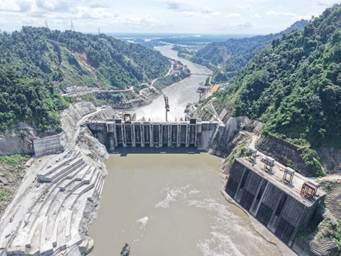
Subansiri Lower Hydroelectric Project
Event Overview
Unit-2 (250 MW) of the 2000 MW Subansiri Lower Hydroelectric Project was commissioned through virtual inauguration by Shri Manohar Lal, Union Minister of Power, Housing & Urban Affairs.
Located on the Subansiri River, a tributary of the Brahmaputra, in Arunachal Pradesh and Assam.
The project consists of 8 units of 250 MW each, making it India’s largest hydropower project.
Source: PIB
Strategic Significance
Supports India’s Net Zero and renewable energy goals.
Enhances power supply in North-East India and strengthens the national grid.
Provides reliable renewable energy to meet growing demand across 16 beneficiary states.
Allocates free power to Arunachal Pradesh and Assam, and 1,000 MW to the North-East region.
Technical and Engineering Highlights
Run-of-the-River scheme with small pondage, diverting water through 8 Head Race Tunnels (HRTs).
Generates 7,422 million units (MU) of renewable electricity annually.
Features India’s largest dam in North-East: 116-metre-high concrete gravity dam.
Implements flood moderation, with a 442 million cubic metre flood cushion.
Innovations include:
Heaviest hydro generator rotors and largest stators
Largest main inlet valves in India
First use of Rotec’s Tower Belt for dam concreting
Nation’s largest aggregate processing and high-capacity batching plants.
Socio-Economic Impact
During construction, ~7,000 locals engaged daily, generating direct and indirect employment.
Promotes local industries such as piggery, sericulture, handloom through IRMA-supported programs, benefiting ~5,000 women.
Expected to spur small-scale industries, tourism, and river navigation, reducing outmigration.
Environmental & River Management
Extensive riverbank protection and erosion control along Subansiri River, covering 60 km with an investment of ₹522 crore.
Flood cushioning and reservoir management protect downstream communities.
Designed as first cascaded dam on Subansiri River.
Future Plans
Next 3 units to be commissioned shortly; remaining 4 units by 2026–27.
Upon full commissioning, will significantly increase India’s renewable energy capacity and strengthen grid resilience.
NHPC Achievements
Installed capacity: 8,333 MW from 30 stations
Projects under construction: 9,704 MW from 14 projects
Diversified into solar, wind, and green hydrogen
Reinforces NHPC’s role as a 100% Green Energy Company supporting India’s clean energy transition.