
Major Strategic Reforms in Telecom sector for 2026
Implemented by the Department of Telecommunications (DoT) through the National Centre for Communication Security (NCCS).
1. Extension of Pro Tem Security Certification Scheme
- Extended for 2 years starting 01 January 2026.
- Originally introduced in October 2024 to prevent disruption due to mandatory security certification.
- Allows OEMs to:
- Self-declare compliance with most ITSAR requirements.
- Continue selling products while formal testing is ongoing.
- Validity extended earlier from 6 months to 2 years (December 2025 decision).
- Expanded product coverage includes:
- IP Routers
- Wi-Fi CPE
- 5G Core (SMF)
- Optical Line Terminal (OLT)
- Optical Network Terminator (ONT)
- New product launches
- 107 Pro Tem certificates issued so far.
- OEMs must address any security gaps identified during testing.
Analysis:
- Reduces product launch delays.
- Balances national security with business continuity.
- Encourages innovation without compromising security oversight.
2. Reduction in Telecom Security Testing Laboratory (TSTL) Application Fees
- More than 50% reduction in NCCS TSTL designation application fees.
- Aims to expand India’s telecom security testing infrastructure.
Key Structural Changes:
- Simplified fee structure replacing complex slabs.
- Lower and predictable costs for:
- First-time applications
- Scope expansion
- Renewals
Special Incentives:
- 50% fee reduction for:
- Indian startups
- Micro and Small Enterprises (MSEs)
- Women-owned enterprises
- 100% fee waiver for:
- Central and State Government labs
- IITs and autonomous institutions
- No fees for:
- SSR scope additions with CSR approval
- Currently:
- 9 TSTLs designated
- Covering 27 telecom equipment/network functions
Analysis:
- Encourages private, academic, and public-sector participation.
- Reduces testing bottlenecks and dependence on limited labs.
- Strengthens indigenous telecom security capabilities.
3. Simplification of ITSAR Certification for ONT Devices
- ITSAR for ONTs notified on 24 November 2023.
- Certification timeline:
- Voluntary from 01 August 2024
- Mandatory from 01 January 2026
- Problem identified:
- Multiple ONT variants had different hash values despite identical software.
- Each variant required separate certification, escalating costs.
- NCCS solution:
- Grouping customized ONT variants under a single certification process.
- Reduces testing cases by approximately 10 times.
Analysis:
- Major cost and time savings for OEMs.
- Ensures business continuity in broadband deployment.
- Maintains security assurance while eliminating redundant testing.
Supporting Reforms & Regulatory Framework
- NCCS operates under the ComSec scheme.
- Security certification mandated under:
- MTCTE framework (2017)
- Now governed by Telecommunications Rules, 2025
- July 2025 reforms included:
- Up to 95% reduction in security test evaluation fees.
- Simplified compliance for:
- Highly Specialized Equipment (HSE)
- End-of-Sale / End-of-Life products
Overall Impact & Strategic Significance
- Strengthens national telecom security architecture.
- Reduces compliance costs and timelines for OEMs.
- Encourages domestic manufacturing and testing.
- Improves India’s attractiveness as a global telecom hub.
- Demonstrates a balanced regulatory approach—security-driven yet industry-friendly.
- Reinforces India’s global reputation as a trusted telecom manufacturing and testing destination.
Government Approved Test Centre (GATC)
Policy Background & Context
- Initiative undertaken by the Department of Consumer Affairs, Ministry of Consumer Affairs, Food & Public Distribution.
- 12 Government Approved Test Centre (GATC) certificates awarded to 11 private entities.
- Represents a major reform in India’s legal metrology verification system.
Core Objective of the Reform
- To strengthen the legal metrology verification ecosystem through a structured public–private partnership (PPP) model.
- To enhance accuracy, reliability, and credibility of weights and measures used in:
- Trade
- Industry
- Consumer transactions
- To improve:
- Ease of doing business
- Regulatory efficiency
- Service delivery timelines
Legal & Regulatory Framework
- Reform enabled by the amendment to the Legal Metrology (Government Approved Test Centre) Rules, 2013.
- Amendment notified on 23 October 2025.
- Expanded the scope of GATCs beyond government laboratories.
- Allowed technically qualified private laboratories and industries to:
- Verify
- Re-verify
weighing and measuring instruments.
- Aligns India’s legal metrology framework with international best practices.
Expansion of Instrument Coverage
- 18 categories of weighing and measuring instruments now covered.
- Reflects evolving technological and sectoral requirements across:
- Healthcare
- Transport
- Energy
- Infrastructure
- Consumer services
Covered Instruments Include:
- Water, gas and energy meters
- Flow meters and moisture meters
- Sphygmomanometers and clinical thermometers
- Breath analysers and vehicle speed meters
- Multi-dimensional measuring instruments
- Automatic rail weighbridges
- Non-automatic weighing instruments
- Tape measures
- Load cells, beam scales, counter machines
- Weights of all categories
Digital & Transparent Implementation
- Department launched a dedicated online portal for GATC applications.
- Application window open till 30 November 2025.
- Ensured:
- Transparent
- Time-bound
- Fully digital approval process
- Faster recognition and improved accessibility for eligible private entities.
Expected Benefits & Impact
- Increased availability of verification services across regions.
- Reduced turnaround time for verification and re-verification.
- Faster compliance for:
- Manufacturers
- Traders
- Service providers
- Improved accuracy in consumer-facing instruments such as:
- Weighing scales
- Water meters
- Energy meters
- Enhances consumer trust and ensures fair value in transactions.
Institutional Strengthening
- RRSLs (Regional Reference Standard Laboratories) and NTH (National Test House) continue as deemed GATCs.
- Creates a robust, decentralised nationwide verification network.
- Acts as a force multiplier for State Legal Metrology Departments.
- Enables Legal Metrology Officers to focus on:
- Inspection
- Enforcement
- Consumer grievance redressal
Strategic & Policy Significance
- Supports the vision of Atmanirbhar Bharat by:
- Leveraging domestic technical expertise
- Encouraging private sector participation within a regulated framework
- Promotes a scientific, technology-driven, future-ready legal metrology system.
- Strengthens:
- Consumer confidence
- Fairness in trade
- Regulatory effectiveness
- Positions India’s legal metrology system closer to global standards.
Overall Analysis
- The reform represents a structural shift from a government-only model to a collaborative PPP approach.
- Balances consumer protection with ease of doing business.
- Ensures accuracy in everyday measurements while modernising regulatory infrastructure.
- Marks a significant step toward a transparent, decentralised and efficient legal metrology ecosystem in India.
Maiden Flight Test of Pinaka Long Range Guided Rocket (LRGR-120)
Key Event & Timeline
- Organisation: Defence Research and Development Organisation (DRDO)
- Test Conducted On: 29 December 2025
- Location: Integrated Test Range (ITR), Chandipur
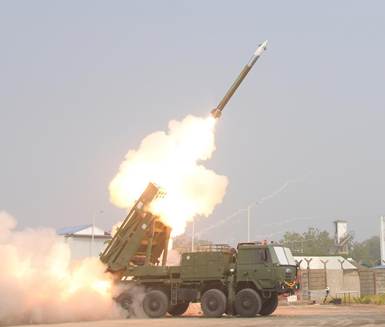
- Milestone: Successful maiden flight test of Pinaka Long Range Guided Rocket (LRGR-120)
Technical Highlights
- Maximum Range Demonstrated: 120 kilometres
- Performance:
- Executed all planned in-flight manoeuvres
- Hit the target with high (“textbook”) precision
- Tracking:
- Entire trajectory monitored by range instrumentation systems
- Launch Platform:
- Fired from the in-service Pinaka multi-barrel rocket launcher
- Key Advantage:
- Confirms compatibility of multiple Pinaka variants (different ranges) with the same launcher
Design & Development
- Lead Design Agency:
- Armament Research and Development Establishment (ARDE)
- Key Collaborating Labs:
- High Energy Materials Research Laboratory (HEMRL)
- Defence Research and Development Laboratory (DRDL)
- Research Centre Imarat (RCI)
- Trial Coordination:
- Integrated Test Range (ITR)
- Proof & Experimental Establishment (P&EE)
Strategic & Operational Significance
- Enhances firepower and precision strike capability of the Indian Armed Forces.
- Combines:
- Long range
- High accuracy
- Guided rocket technology
- Reduces dependence on imported precision artillery systems.
- Acts as a force multiplier in conventional warfare scenarios.
- Strengthens India’s indigenous rocket and artillery ecosystem.
INSV Kaundinya – Maiden Overseas Voyage
Key Event & Timeline
- Vessel: Indian Naval Sailing Vessel (INSV Kaundinya)
- Voyage Commenced: 29 December 2025
- Route: Porbandar (Gujarat, India) → Muscat (Sultanate of Oman)
- Significance: Maiden overseas voyage of the vessel
- Represents a historic maritime expedition reconnecting India with its ancient seafaring traditions.

Unique Features of INSV Kaundinya
- Indigenously built traditional sailing vessel of the Indian Navy.
- Constructed using ancient stitched shipbuilding techniques.
- Built with:
- Natural materials
- Traditional tools and methods
- Techniques date back several centuries, based on:
- Historical texts
- Iconographic and archaeological evidence
- Reflects India’s legacy of:
- Indigenous shipbuilding
- Seamanship
- Ocean navigation
Historical & Cultural Significance
- Voyage retraces ancient maritime trade routes linking:
- Western coast of India (especially Gujarat)
- Oman and the Arabian Peninsula
- These routes historically enabled:
- Trade
- Cultural exchange
- Civilisational interactions across the Indian Ocean
- Highlights Gujarat’s long-standing maritime ties with Oman.
Strategic & Diplomatic Importance
- Strengthens India–Oman bilateral relations.
- Reinforces:
- Shared maritime heritage
- Cultural and people-to-people ties
- Arrival at Muscat expected to act as a:
- Symbol of friendship
- Testament to centuries-old mutual trust and cooperation
- Exemplifies maritime diplomacy through heritage and culture, not military power.
Role of the Indian Navy
- Demonstrates commitment to:
- Heritage preservation
- Maritime diplomacy
- Regional cooperation in the Indian Ocean Region (IOR)
- Positions India as:
- A civilisational maritime nation
- A culturally rooted and responsible stakeholder in IOR
- Complements India’s broader soft power and SAGAR vision (Security and Growth for All in the Region).
National Technology Readiness Assessment Framework (NTRAF)
Key Event & Announcement
- Event: Launch of the National Technology Readiness Assessment Framework (NTRAF)
- Date: 29 December 2025
- Announced By: Prof. Ajay Kumar Sood, Principal Scientific Adviser (PSA) to the Government of India
- Purpose: Standardise the assessment of technology maturity from laboratory research to commercial deployment
- Collaboration: Developed in collaboration with Confederation of Indian Industry (CII)
- Public Consultation: Open until 31 January 2026
Objectives of NTRAF
- Provide a common, objective “language” between researchers, investors, and funding bodies
- Bridge the “Valley of Death” between Technology Readiness Levels -TRL 4 (prototype development) and Technology Readiness Levels – TRL 7 (operational deployment), where funding often dries up
- De-risk early-stage technologies for private investment
- Serve as the operational backbone for R&D funding under National Missions and RDI Fund
- Ensure funding is directed toward scalable, market-ready solutions, not just experiments
Key Features of the Framework
- Technology Readiness Levels (TRLs):
- Covers TRL 1-9, from Proof of Concept (TRL 1-3) to Prototype Development (TRL 4-6) and Operational Deployment (TRL 7-9)
- Evidence-Based Assessment:
- Replaces subjective evaluations with structured, objective checklists for each stage
- Sector-Specific Annexures:
- Special provisions for Healthcare & Pharmaceuticals, Software, and other sectors
- Self-Assessment Tool:
- Enables project investigators to identify technical gaps before seeking funding
- Alignment with Global Standards:
- Adapted from frameworks like NASA TRL, but tailored to the Indian innovation ecosystem
Stakeholders & Roles
- Office of PSA (OPSA): Lead coordination and scientific oversight
- Anusandhan National Research Foundation (ANRF): Support in implementation and evaluation
- Department of Science & Technology (DST): Backing RDI Fund and high-risk, high-reward projects
- Industry (CII): Ensures standards align with industrial-grade deployment readiness
- NRDC: Proposed pilot phase to cross-validate 20 selected technologies before full adoption
Strategic Importance
- Bridges academia–industry gap:
- Standardises communication on readiness between researchers and investors
- Reduces risk in innovation funding:
- Enables precise allocation of resources to high-potential technologies
- Encourages commercialization:
- Ensures technologies are deployment-ready rather than just lab-validated
- Supports India’s deeptech ecosystem:
- Encourages startups and research institutions to adhere to a rigorous, objective assessment process
- Promotes transparency and accountability in government R&D funding
Documentary Filmmaker S. Krishnaswamy
Personal Background
- Full name: S. Krishnaswamy
- Birth: July 15, 1937, Chennai (then Madras)
- Parents: Iconic director K. Subrahmanyam and lyricist Meenakshi Subrahmanyam
- Education: Studied mass communications at Columbia University, U.S., specializing in documentary films (1960)
- Family: Survived by wife Mohana Krishnaswamy and children Latha Krishna, Gita Krishnaraj, Bharat Krishna
- Death: Passed away at 88 in Chennai on Sunday 28/12/25, after treatment for a heart ailment
Career Highlights
- Founded Krishnaswamy Associates in 1963.
- Produced over 900 non-fiction films, covering history, politics, culture, and social issues.
- Notable documentaries:
- Indus Valley to Indira Gandhi (1976) – 4-hour film spanning 5,000 years of Indian history; shot in 100 locations; distributed internationally by Warner Brothers.
- Unknown Freedom Fighters (1978)
- Rajaji (1979), Kamaraj (1981)
- With Apologies to Tagore (1987) – animated political satire
- Jaya Jaya Sankara (1991), Reality Behind Religion (1992)
- Films on R. Venkataraman, C. Subramaniam (2002), M.G. Ramachandran (1984)
- Addressed issues like Punjab and Sri Lanka conflicts, Indian defense operations, and electoral reforms (Who loses when India wins, 2006)
Awards and Recognition
- Padma Shri (2009) – Government of India
- Dr. V. Shantaram Lifetime Achievement Award (2020) – Mumbai International Film Festival
- Honor Summus Award – Watumull Foundation, Hawaii (1987)
- Lifetime Achievement Award – U.S. International Film and Video Festival, Los Angeles (2005)
Literary Contributions
- Authored Voyages Retraced: India’s Influence in East Asia (2025)
- Explored ancient India’s cultural impact on Southeast Asia
- Covered Indian sailors’ influence on countries like Vietnam, Laos, Cambodia, and Thailand
- Based on his travels from 2005–2010
- Co-authored Indian Film with Erik Barnouw
- During research, stayed in Darjeeling while Satyajit Ray filmed Kanchenjunga
Legacy
- Pioneered documentary filmmaking in India, blending history, politics, and social issues.
- Films emphasized national history, cultural awareness, and communal harmony.
- Received international acclaim, with his works screened globally.
- Inspired future generations of documentary filmmakers with both volume and depth of work.
Rare-Earth Elements (REEs)
1. Definition and Composition of Rare-Earth Elements (REEs)
- REEs are a group of 17 metallic elements:
- Lanthanides (15): lanthanum (La) → lutetium (Lu)
- Others: scandium (Sc) and yttrium (Y)
- Position in the periodic table:
- Lanthanides are usually shown as a separate row below the main table.
- Scandium and yttrium are part of Group 3, above the transition metals.
- Why they’re called “rare”:
- They are relatively abundant in the Earth, but usually spread thinly and mixed in the same mineral deposits.
- Separating them individually is chemically difficult and expensive.
Example: A ton of ore may contain small amounts of several REEs, requiring labor-intensive processes to extract each one.
2. Historical Background
- Term “rare earth” comes from old chemistry, where “earth” meant oxide powder.
- Early chemists discovered these elements as oxides, which were hard to isolate in pure form.
- Confusion in terminology:
- Some consider only lanthanides as rare-earths.
- Others include other “critical metals” like lithium or cobalt (not technically REEs).
3. Properties and Applications
- REEs are chemically similar, but their 4f electrons give them unique magnetic, electrical, and optical properties.
- Key applications:
- Magnets:
- Neodymium-iron-boron (NdFeB) magnets → motors, generators, wind turbines, electric vehicles.
- Phosphors & lighting:
- Europium & terbium → fluorescent lamps, LEDs, display screens.
- Optical devices:
- Neodymium & erbium → lasers, fiber optics.
- Catalysts, glass, ceramics, polishing powders: used in chemical reactions and high-performance materials.
- Magnets:
Example: Electric car motors rely on neodymium magnets for high efficiency and compact size.
4. Magnetic Chemistry and Optical Properties
- 4f electrons:
- Sit close to the nucleus → relatively unaffected by surrounding atoms.
- Maintain a strong magnetic moment → each atom acts like a tiny magnet.
- Permanent magnets: need:
- Large magnetization: many atomic moments aligned.
- Stability: magnetic moments resist heat, vibration, or opposing fields.
- Why REEs are ideal for magnets:
- 4f electrons provide high magnetic moment.
- Magnetocrystalline anisotropy pins magnetization in a stable direction.
- Phosphors: 4f electrons absorb energy and emit light at precise, stable wavelengths → sharp colors for LEDs, displays, and lasers.
Example: Europium in red LEDs emits pure red light, which wouldn’t be possible with common metals.
5. Mining and Extraction
- Common ore minerals: bastnäsite, monazite, clay deposits.
- Mining: often open-pit, involves crushing and moving large amounts of ore. Some ores contain thorium or uranium, creating radioactive waste risks.
Processing steps:
- Beneficiation: separate valuable minerals using flotation, magnets, or gravity.
- Chemical cracking: strong acids/bases or heat make REEs soluble.
- Leaching: dissolve REEs into solution as ions.
- Separation: solvent extraction—multi-stage to separate chemically similar ions.
- Recovery: precipitate REEs as oxides → optional reduction to metals for magnets.
Challenges:
- REEs have similar chemical behavior, so separation is slow, energy-intensive, and requires many stages.
- Waste streams may be radioactive or chemically hazardous, requiring careful treatment.
Example: Separating neodymium from praseodymium in monazite may require dozens of solvent extraction stages to reach high purity.
6. Comparison with Oil
- Oil refining: uses fractional distillation; feedstocks can be substituted if needed.
- REE refining: requires precise separation; each element must meet high-purity standards.
- Strategic difference:
- A country with REE mines but no refining capacity cannot reliably supply magnets or electronics.
Implication: REEs are a strategic resource for high-tech and green technologies, unlike crude oil, which can be processed flexibly.
7. Global Supply and Strategic Importance
- Reserves (million tonnes, MT):
- China: 44
- Brazil: 21
- India: 6.9
- Australia: 5.7
- Russia: 3.8
- Vietnam: 3.5
- U.S.: 1.9
- Greenland: 1.5
- China dominates:
- ~91% of rare-earth refinement and separation
- ~94% of sintered REE permanent magnets
- Strategic moves:
- Countries are investing in midstream processing and magnet production, not just mining.
- Japan plans underwater REE mining off Minamitori Island in 2026.
Example: Even with large U.S. reserves, the U.S. depends on China for high-purity NdFeB magnets.
8. Key Takeaways
- REEs are technically abundant but economically and chemically challenging to isolate.
- Their 4f electron properties make them essential in:
- High-performance magnets
- Lasers, fiber optics, LEDs
- Catalysts and specialty materials
- Processing is complex and energy-intensive, with environmental challenges.
- Global supply is concentrated, especially in China → geopolitical and economic significance.
Vizhinjam International Seaport
1. Overview of the Port
- Vizhinjam International Seaport is developed and operated by Adani Ports and Special Economic Zone Ltd. (APSEZ) in partnership with the Kerala government.
- The port has achieved a major milestone by handling 1 million TEU (twenty-foot equivalent units) of cargo within just 10 months of commencing operations.
- This performance is exceptional for a newly commissioned port.
2. Strategic Location Advantage
- The port is located very close to major east–west international shipping lanes, which carry a large share of global maritime trade.
- This proximity allows large container vessels to dock without major deviation, reducing time and fuel costs.
- As a result, Vizhinjam is emerging as a global transshipment hub, competing with established ports like Colombo, Singapore, and Dubai.
3. Deep-Water and Technical Capabilities
- Vizhinjam is a natural deep-water port, capable of handling the world’s largest container ships, including ultra-large container vessels (ULCVs).
- It has already handled:
- 650 vessels in its inaugural year
- 1.4 million TEU cargo
- 43 ultra-large container vessels (Dec 2024–2025), the highest at any Indian port
- 154 vessels longer than 300 metres
- These figures indicate the port’s high operational efficiency and global acceptance.
4. Economic and Trade Significance
- The port’s rapid success:
- Strengthens India’s role in global logistics and maritime trade
- Reduces India’s dependence on foreign transshipment hubs
- Enhances supply-chain competitiveness
- It opens new opportunities for:
- Trade expansion
- Employment generation
- Regional economic development in Kerala and southern India
5. Infrastructure Expansion – Phase II and Beyond
- According to Kerala Ports Minister V.N. Vasavan, the second phase of development is expected to be inaugurated in mid-January.
- The second, third, and fourth phases will involve an investment of ₹9,700 crore by the Adani Group.
- Planned infrastructure upgrades include:
- Expansion of berth length from 800 metres to 2,000 metres
- Extension of the 2.96 km breakwater by an additional 9.2 metres
- These expansions will significantly increase the port’s capacity and resilience, enabling higher cargo volumes and larger ships.
6. National and Global Importance
- Vizhinjam’s performance:
- Elevates India’s global maritime standing
- Positions India as a serious competitor in transshipment services
- Aligns with India’s broader goals of becoming a global logistics and trade hub
- The port represents a shift from being a cargo-origin/destination port to a hub port in global shipping networks.