
The Martian Moons eXploration (MMX) mission will be the first mission to collect a sample from Mars’s moon Phobos and bring it back to Earth. This mission is led by the Japan Aerospace Exploration Agency (JAXA), in collaboration with the National Aeronautics and Space Administration (NASA), the French space agency (CNES), the German Aerospace Center (DLR) and the European Space Agency (ESA).
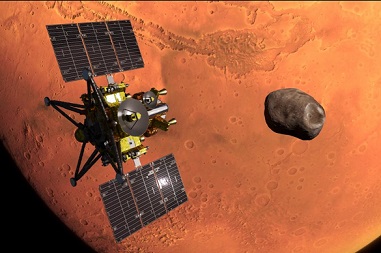
This mission is set to launch into space from the Tanegashima Space Center on a H3 rocket on 20 October 2026.
Why the Martian Moons?
A Mystery Waiting to Be Solved
More than four billion years ago, as the Solar System was taking shape, Mars began its long journey of transformation. Today, the Red Planet has two small moons orbiting around it: Phobos, meaning “fear,” and Deimos, meaning “terror.” Although Mars has been explored by numerous spacecraft, its two moons remain among the most mysterious objects in our planetary neighbourhood.
We still know remarkably little about these tiny worlds. Most of our knowledge comes from brief spacecraft flybys, as no mission has spent an extended period exploring them up close. Their origin remains one of the biggest unanswered questions in planetary science.
Did Phobos and Deimos begin their lives as asteroids captured by Mars’s gravity? Or did they form from debris thrown into orbit when a giant object collided with the planet? Both possibilities could reveal important clues about the early Solar System, but finding the answer requires something more than distant observations: we need samples from the moons themselves.
This is where the Martian Moons eXploration (MMX) mission comes in.
“The data and samples returned by MMX are a window to study the evolution of Mars and the Solar System,” says Elliot Sefton-Nash, ESA MMX Project Scientist.
By bringing material from Phobos back to Earth, MMX aims to uncover the history of the Martian moons and shed light on the processes that shaped our planetary neighbourhood.
Why the Martian Moons Matter
The story of Phobos and Deimos is closely connected to the story of Mars itself. Like Earth, Mars has changed dramatically since it formed around 4.5 billion years ago. Evidence suggests that the planet may once have had conditions suitable for life.
Understanding the origin and composition of its moons could help scientists reconstruct the early history of Mars, investigate how rocky planets formed, and learn more about the evolution of the Solar System. These discoveries could even help us understand how rocky planets around other stars come into existence.
In other words, studying two small moons could help answer some very big questions about our cosmic origins.
A Mission Like No Other
To solve these mysteries, MMX will undertake a journey filled with several historic firsts. It will be the first spacecraft to orbit Phobos in a quasi-satellite orbit and the first mission to collect samples from the surface of a moon beyond Earth’s Moon.
The mission will also demonstrate technologies needed to operate in Phobos’s extremely weak gravity. Landing, moving across the surface, and collecting material in such an environment pose unique engineering challenges. Special robotic technologies have therefore been developed to make these operations possible.
But MMX’s ambitions do not end with reaching Phobos. After completing its exploration, the spacecraft will begin the journey back to Earth, making it the first mission to return home after visiting the Mars system. The experience gained could help shape future sample-return missions from Mars and potentially support the development of technologies for human exploration of the planet.
Exploring Phobos, One Step at a Time
The MMX mission will unfold in several stages, with each step bringing scientists closer to understanding Phobos.
First, the main spacecraft will study the moon from a distance, mapping its surface and gathering scientific observations. It will then deploy a small rover named Idefix to the surface.
Weighing approximately 25 kilograms on Earth, Idefix has two main objectives. It will examine the composition and texture of Phobos’s surface and gather information to help prepare for the main spacecraft’s eventual landing and sample collection.
Phobos’s gravity is so weak that the rover would weigh the equivalent of just 15 grams on its surface. Moving and operating under these conditions requires careful engineering and new approaches to mobility.
Once the rover has completed its work, the main spacecraft will descend to Phobos and collect samples. These precious fragments of the moon will be packed into a return module for the journey back to Earth.
Throughout the mission, MMX will carry out an extensive scientific investigation using 11 science instruments: seven on the main spacecraft and four on the rover. The main spacecraft will also carry a radiation monitor, two high-resolution cameras, and two different sampling devices.
Together, these instruments will help scientists study the moons’ physical properties, surface features, and composition, building a more complete picture of their history.
A Journey Through the Mars System
MMX’s journey will take it far beyond a simple visit to Phobos. Along the way, it will also investigate Deimos and Mars itself, helping scientists understand how the moons relate to their parent planet.
The mission is expected to take around a year to reach Mars, with arrival anticipated in August 2027. It is expected to begin orbiting Phobos in September 2027 after reaching the Martian system and establishing its operations. Following its initial observations of Phobos and Deimos, the spacecraft is scheduled to release Idefix in early 2029.
MMX will not be exploring Mars in isolation. ESA’s Mars Express spacecraft, whose operations are confirmed until at least 2029, may support the mission’s observations. Meanwhile, ESA’s upcoming ExoMars Rosalind Franklin rover will complement MMX by collecting samples from beneath the Martian surface and analysing them with its onboard laboratory.
Together, these missions will investigate Mars and its surroundings from different perspectives, helping scientists connect the planet’s geological history with the origin and evolution of its moons.
Bringing a Piece of Phobos Home
In 2030, MMX is planned to land on Phobos and collect samples for the return journey. After the material has been secured in a dedicated return module, the spacecraft will begin its journey back to Earth.
The sample-return capsule is expected to arrive in 2031, carrying at least 10 grams of material from Phobos. Although this may seem like a tiny amount, even a few grains of extraterrestrial material can contain an extraordinary wealth of scientific information.
The capsule is planned to land in Australia before the samples are transferred to Japan. There, scientists will extract and catalogue the material before making it available for study by mission partners.
European scientists are also expected to have opportunities to investigate the samples. ESA is working with the French space agency CNES, the German Aerospace Center DLR, and the Japan Aerospace Exploration Agency JAXA to provide opportunities for researchers to work with this rare material.
The value of these samples will extend far beyond the mission itself. As technology advances, future generations of scientists will be able to revisit the material using instruments that do not yet exist, potentially uncovering discoveries that today’s researchers cannot even anticipate.
A Small Moon, A Giant Leap in Understanding
The MMX mission represents much more than an expedition to two small moons. It is an attempt to answer fundamental questions about the birth of planetary bodies, the evolution of Mars, and the history of the Solar System.
By exploring Phobos, investigating Deimos, and bringing samples back to Earth, MMX could transform our understanding of these enigmatic moons and the planet they orbit.
The samples may weigh only a few grams, but the answers they hold could reach billions of years into the past—and help us better understand the origins of worlds across the universe.